
Introduction for: Year 1, Lesson 11

Burning Bush

The Big Idea (Textual Principle):
God told Moses, “Go.”

Exodus 3

Biblical Virtue (Timeless Principle)
Willingness – We say “Yes” when God sends us.

Memory Verse

And God said unto Moses, I Am That I Am: and he said, Thus shalt thou say unto the children of Israel, I Am hath sent me unto you
Exodus 3:14

Burning Bush

Bible Text: Exodus 3

Answer the following questions:

After asking these for yourself, you will be ready to ask these questions of the students after you tell the story.
Question Answer
What did you like in the story?  
What did you not like in the story? 
What does the story teach you about God? 
What does the story teach you about mankind? 
What might the Lord be calling you to do after hearing this story? 

Teacher Soft Skills Development

Create 5 Questions and answers to thoughtfully review the text.
Question Answer
Who  
What  
When  
Where  
Why  
How  


Sign-Up or login now for free access!

Classroom Sequence for Burning Bush (Exodus 3)

#1 Welcome the Students

AHello students, please sit down and stay quiet for prayer.”

BPray and praise God for a beautiful day, and
ask God to bless the teacher and students.

#2 Rules Review

Use the rules chart to remind everyone to sit, listen, watch, put away their toys/personal items, and have fun.

#3 Music

Sing two or more joyful songs.

#4 Five-Finger Prayer Time

Thumb
Praise God for His
worthy character

Index Finger
Confess sins

Middle Finger
Thank God for
His great care

Ring Finger
Pray for those
who are weak
or in need

Pinky
Pray for my own
needs

#5 Bible Time

Use the rules chart to remind everyone to sit, listen, watch, avoid toys, and have fun.

#6 Story Time

Sign-Up or login now for free access!

Start by sharing the big idea: “God told Moses, “Go.””

Engage: Before we hear today’s story, I have an important job for you. Today, you are going to be Bible detectives. Bible detectives listen very carefully and notice what is happening in the story. In today’s story, God has an important assignment for the person in our story. This person is Moses, and he is grown up and working as a shepherd, taking care of the sheep, and is not expecting the new job he needs to do. God does something that helps the person stop and pay attention. While I tell the story, listen carefully and observe this: What does the person notice that helps them pay attention to God?

Expound: Tell the Story (5-10 minutes)
1. Mention the historical situation.
2. Begin: “This is a true story from God’s
Word.”
3. Tell accurately with gestures/pictures.
(Accurate/Transferable/Contextual/Short)

Explain (Before or after the story – not during):
1. Share insights and biblical principles.
2. Compare with Jesus or NT when appropriate.
3. Identify Christian virtue(s): Willingness – We say “Yes” when God sends us. 
4. Apply an example to real life.

Note: Learning to read the full passage and accurately retell a short version is part of the personal development of the teacher.

#7 Expand

Do 2 or 3 of the following as time permits. The teacher does not have to do everything listed – just choose according to the time permitted.

A. Retell the Story so the students can memorize it.

If possible, tell the story again so the students can memorize it.

B. Craft

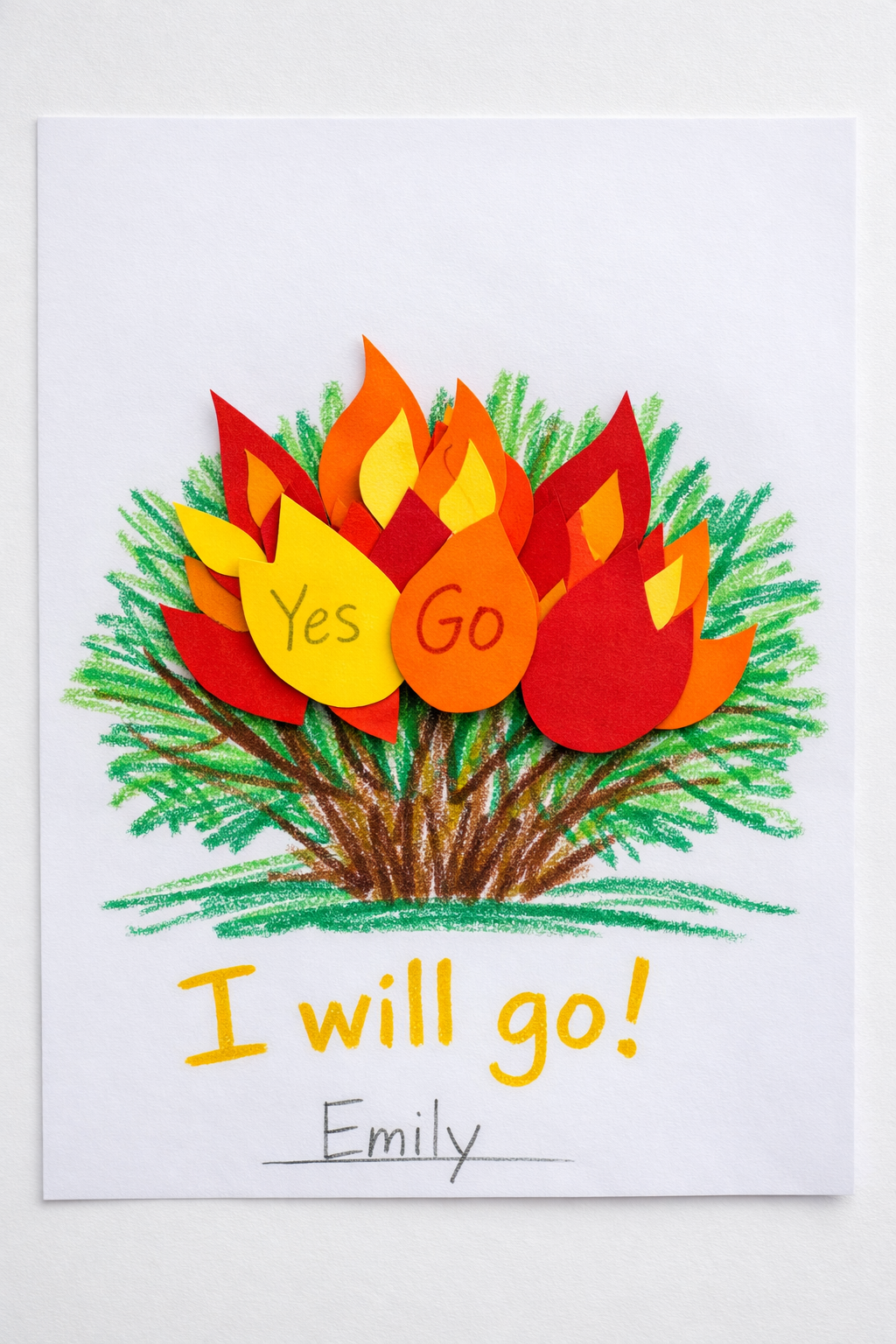
Flame Collage 

Materials

  • White paper (one sheet per child)

  • Crayons (red, orange, yellow, green, brown)

  • Glue sticks

  • Scissors

Instructions

  1. Draw the Bush

    • Have the children draw a big bush with green and brown crayons.

    • Encourage them to make it “messy” with lots of branches — it doesn’t need to be perfect.

  2. Create Flames

    • Children color patches of red, orange, and yellow on scrap paper.

    • Cut out simple flame shapes (pointed ovals or teardrops).

    • At this age, they can handle cutting with some guidance.

  3. Glue Flames to the Bush

    • Glue the flames onto the bush drawing, overlapping colors to look like fire.

    • Talk about how the bush burned but wasn’t destroyed — God was there.

  4. Add the Verse

    • At the bottom, help them write: “God said, Go!” (Exodus 3:10).

    • They can sign their names or a simple mark (like a handprint or scribble)

    • to show their personal “Yes.”

C. Total Physical Response

Part 1: Setting Up the Mime Choir

Lining Up the Group

  1. Ask children to stand in 2–3 straight rows, all facing the same direction.
  2. Children should have:
    • Arms stretched out to the side without touching others
    • Feet facing forward
  3. Say:

    “We are going to move together, quietly, like one group.”

Mime Choir Rules (Say Simply)

  • We move at the same time
  • We move slowly and carefully
  • When we freeze, we are very still
  • No talking during the mime

Practice once:

  • Everyone freezes
  • Everyone relaxes

Part 2: Teaching the Four Mime Sections

(Do this once before performing the full mime.)

Explain:

“This is a silent story. I will show the moves, and we will all move together.”


Part 3: The Mime Choreography

(Everyone moves in unison. Teacher models at the front.)

1. SHEPHERDING — Normal Life

Slow, calm, steady

  1. Walk slowly in place
    • Same speed, small steps
  2. Look left, then right
    • Slow head movement
  3. Lean gently on a staff
    • One hand resting, calm body

Hold the pose for 2 counts


2. FIRE — Something Gets Attention

Sudden but controlled

  1. Stop walking together
    • Feet freeze at the same time
  2. Raise hands, fingers wiggling
    • Hands chest‑high, not wild
  3. Lean forward slightly
    • Eyes focused ahead

Hold for 2 counts


3. WORSHIP — A Holy Moment

Very slow and quiet

  1. Slowly pretend to take off shoes
    • One foot, then the other
  2. Place shoes carefully to the side
    • Gentle, respectful movement
  3. Stand very still
    • Hands down, eyes forward

Hold this stillness for 3–4 counts (longest pause)


4. LISTENING — God Speaks

Small, focused movements

  1. Cup hand to ear
    • Elbows tucked in
  2. Nod slowly once
    • Understanding
  3. Take one small step forward
    • Ready to respond

End in stillness

Optional final pose:

  • Hand on heart (God is with me)

Part 4: Performing as a Mime Choir

First Time

  • Teacher quietly says the section titles only:
    • “Shepherding”
    • “Fire”
    • “Worship”
    • “Listening”

Second Time

  • No words at all
  • Teacher leads only with movement