
Introduction for: Year 1, Lesson 14

Manna & Water

The Big Idea (Textual Principle):
God takes care of His people on purpose and wants us to trust Him

Exodus 16–17

Biblical Virtue (Timeless Principle)
Contentment – We thank God for what we have.

Memory Verse

The young lions do lack, and suffer hunger: but they that seek the Lord shall not want any good thing. -Psalm 34:10

Manna & Water

Bible Text: Exodus 16–17

Answer the following questions:

After asking these for yourself, you will be ready to ask these questions of the students after you tell the story.
Question Answer
What did you like in the story?  
What did you not like in the story? 
What does the story teach you about God? 
What does the story teach you about mankind? 
What might the Lord be calling you to do after hearing this story? 

Teacher Soft Skills Development

Create 5 Questions and answers to thoughtfully review the text.
Question Answer
Who  
What  
When  
Where  
Why  
How  


Sign-Up or login now for free access!

Classroom Sequence for Manna & Water (Exodus 16–17)

#1 Welcome the Students

AHello students, please sit down and stay quiet for prayer.”

BPray and praise God for a beautiful day, and
ask God to bless the teacher and students.

#2 Rules Review

Use the rules chart to remind everyone to sit, listen, watch, put away their toys/personal items, and have fun.

#3 Music

Sing two or more joyful songs.

#4 Five-Finger Prayer Time

Thumb
Praise God for His
worthy character

Index Finger
Confess sins

Middle Finger
Thank God for
His great care

Ring Finger
Pray for those
who are weak
or in need

Pinky
Pray for my own
needs

#5 Bible Time

Use the rules chart to remind everyone to sit, listen, watch, avoid toys, and have fun.

#6 Story Time

Sign-Up or login now for free access!

Start by sharing the big idea: “God takes care of His people on purpose and wants us to trust Him”

Engage:

StepWhat the Teacher DoesWhat Students DoPurpose / Connection
1. Scenario SetupDescribe a situation where a big problem was just solved, but new discomfort immediately follows (no food, water, safety, or certainty).Listen and imagine themselves in the situation.Creates emotional context similar to Israel after the Exodus.
2. Silent ReflectionAsk reflective questions: “What would bother you most?” “What would you complain about first?” “Who would you blame?”Think quietly (or write briefly).Promotes self‑awareness and empathy before judging Israel.
3. SharingInvite a few students to share their thoughts (no correcting or debating).Share complaints or anxieties they identified.Normalizes human fear, frustration, and uncertainty.
4. Transition to ScriptureSummarize: Israel faced hunger, thirst, danger, and uncertainty—and reacted like real people.Shift attention toward the biblical text.Smoothly introduces Exodus 16–17 themes: trust, need, and God’s response.

Expound: Tell the Story (5-10 minutes)
1. Mention the historical situation.
2. Begin: “This is a true story from God’s
Word.”
3. Tell accurately with gestures/pictures.
(Accurate/Transferable/Contextual/Short)

Explain (Before or after the story – not during):
1. Share insights and biblical principles.
2. Compare with Jesus or NT when appropriate.
3. Identify Christian virtue(s): Contentment – We thank God for what we have. 
4. Apply an example to real life.

Note: Learning to read the full passage and accurately retell a short version is part of the personal development of the teacher.

#7 Expand

Do 2 or 3 of the following as time permits. The teacher does not have to do everything listed – just choose according to the time permitted.

A. Retell the Story so the students can memorize it.

If possible, tell the story again so the students can memorize it.

B. Craft

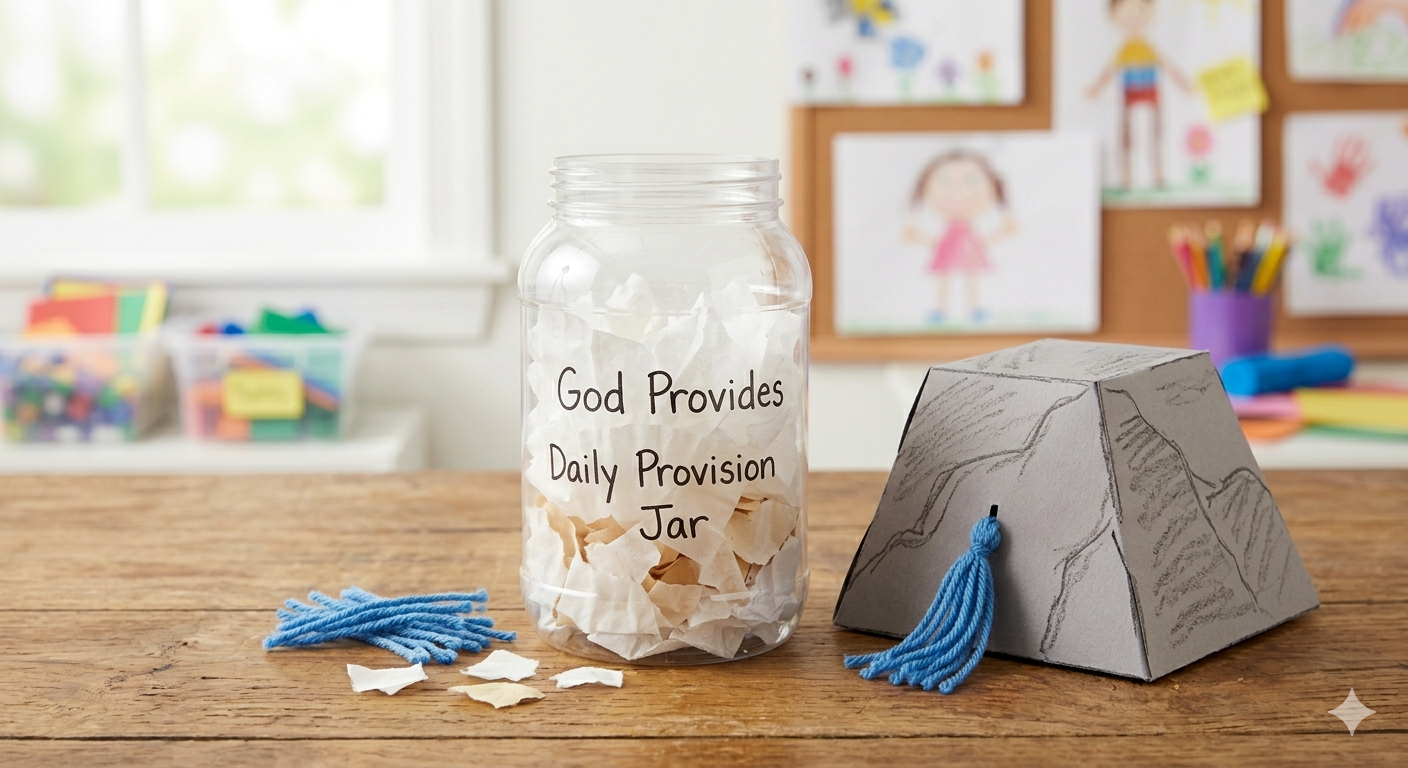
Manna & Water Craft Manna & Water Craft

The "Daily Provision" Gathering Jar

This craft helps students act out the story by creating a "gathering jar" for manna and a "rock" that dispenses water


Materials

  • 1 Empty Plastic Jar or Cardboard Container (to serve as the omer/gathering jar)

  • A Coffee Filter or White Tissue Paper (to represent manna).....

  • Create the Manna: Have the children tear or cut small pieces of white coffee filters or tissue paper

  • Construct the Rock: Take a separate piece of grey construction paper and fold it into a tent-like shape to look like a rock.

  • The Water Miracle: Cut a small slit in the "rock." Thread blue yarn or ribbon through the slit so it can be pulled out, representing water flowing from the rock when Moses struck it

  • Interactive Element: Ask the children to place their "manna" flakes into the jar, reminding them that God gave just enough for each day.

    By the end of the lesson, they will have a physical reminder that they can trust God for what they have

C. Total Physical Response

TPR StepTeacher WordsStudent Movement (TPR)
1. God Leads“God led His people into the wilderness.”One arm points forward; slow walking in place
2. God Provides Food“God sent food from heaven—every day.”Reach up; wiggle fingers down like manna; scoop and eat
3. God Provides Water“God made water come from the rock.”Tap fists like striking a rock; fingers flow like water; drink
4. God Protects“God protected His people.”Feet apart; arms raised high like Moses’ staff
5. God Calls for Daily Trust“God wants His people to trust Him every day.”Hands on heart; open palms upward