
Introduction for: Year 1, Lesson 39

Jesus Heals the Paralyzed Man

The Big Idea (Textual Principle):
Jesus has authority over both sickness and sin.

Mark 2:1-12

Biblical Virtue (Timeless Principle)
Hope & Compassion – Jesus brings life and cares for us.

Memory Verse

Son, your sins are forgiven. - Mark 2:5

Jesus Heals the Paralyzed Man

Bible Text: Mark 2:1-12

Answer the following questions:

After asking these for yourself, you will be ready to ask these questions of the students after you tell the story.
Question Answer
What did you like in the story?  
What did you not like in the story? 
What does the story teach you about God? 
What does the story teach you about mankind? 
What might the Lord be calling you to do after hearing this story? 

Teacher Soft Skills Development

Create 5 Questions and answers to thoughtfully review the text.
Question Answer
Who  
What  
When  
Where  
Why  
How  


Sign-Up or login now for free access!

Classroom Sequence for Jesus Heals the Paralyzed Man (Mark 2:1-12)

#1 Welcome the Students

AHello students, please sit down and stay quiet for prayer.”

BPray and praise God for a beautiful day, and
ask God to bless the teacher and students.

#2 Rules Review

Use the rules chart to remind everyone to sit, listen, watch, put away their toys/personal items, and have fun.

#3 Music

Sing two or more joyful songs.

#4 Five-Finger Prayer Time

Thumb
Praise God for His
worthy character

Index Finger
Confess sins

Middle Finger
Thank God for
His great care

Ring Finger
Pray for those
who are weak
or in need

Pinky
Pray for my own
needs

#5 Bible Time

Use the rules chart to remind everyone to sit, listen, watch, avoid toys, and have fun.

#6 Story Time

Sign-Up or login now for free access!

Start by sharing the big idea: “Jesus has authority over both sickness and sin.”

Engage:

Ask students how far they would go to help a friend. Introduce the four friends.

Expound: Tell the Story (5-10 minutes)
1. Mention the historical situation.
2. Begin: “This is a true story from God’s
Word.”
3. Tell accurately with gestures/pictures.
(Accurate/Transferable/Contextual/Short)

Explain (Before or after the story – not during):
1. Share insights and biblical principles.
2. Compare with Jesus or NT when appropriate.
3. Identify Christian virtue(s): Hope & Compassion – Jesus brings life and cares for us. 
4. Apply an example to real life.

Note: Learning to read the full passage and accurately retell a short version is part of the personal development of the teacher.

#7 Expand

Do 2 or 3 of the following as time permits. The teacher does not have to do everything listed – just choose according to the time permitted.

A. Retell the Story so the students can memorize it.

If possible, tell the story again so the students can memorize it.

B. Craft

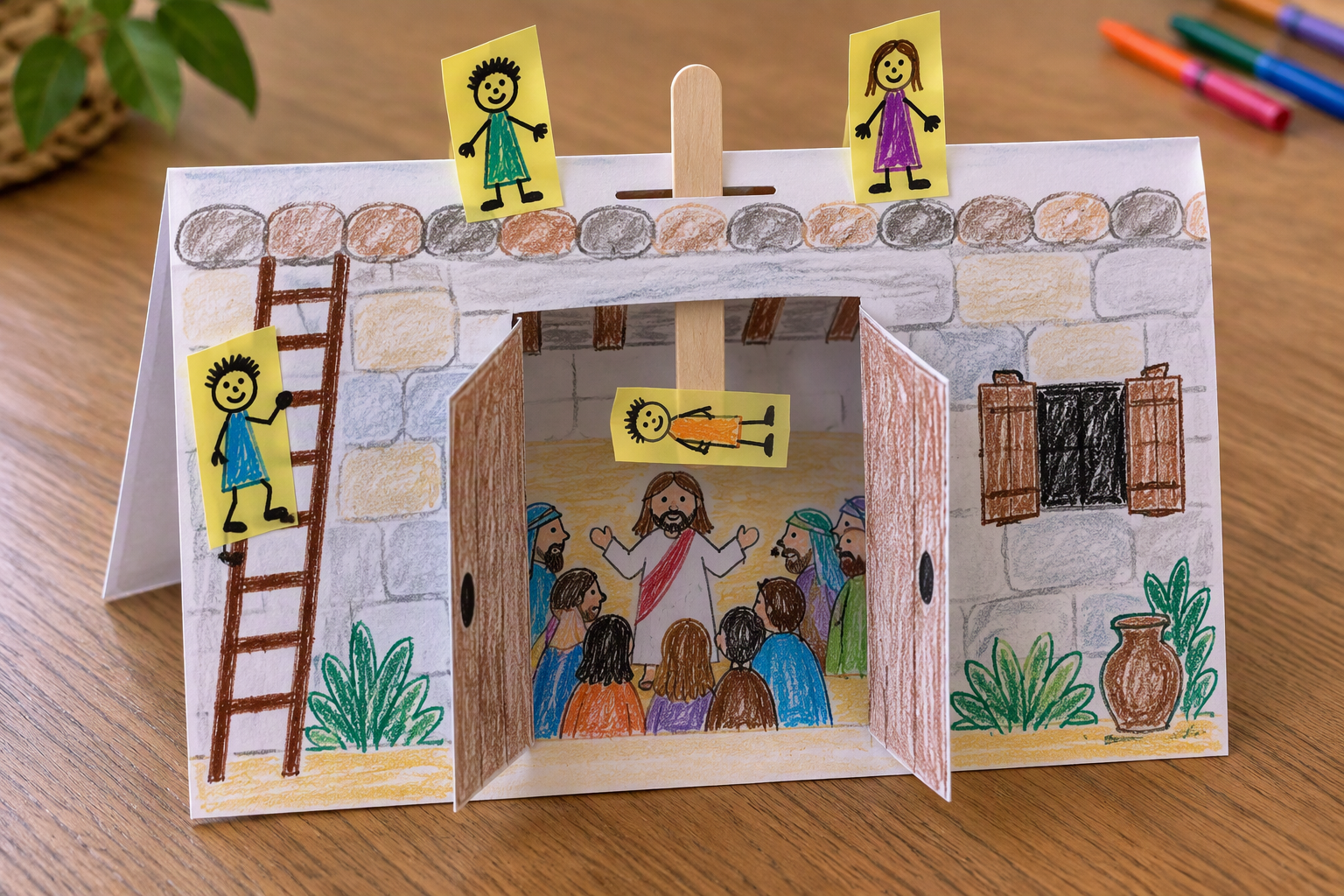
Today we are going to make a craft that helps us tell the story of the four friends who brought a paralyzed man to Jesus.

First, take your piece of cardstock and fold it in half. Stand it up like a tent. The folded top will become the roof of the house.

Next, cut a door in the front of the house. Cut three sides so the door can open and close. Then cut a small slit in the middle of the roof. We will use that opening later when we tell the story.

Now let's decorate the outside of the house. Draw a ladder going up one side of the house so the friends can climb to the roof. Draw a window on the other side. Add plants, bushes, stones, clay jars, or anything else you would like around the outside of the house.

Open the doors and look inside. This is where Jesus is teaching. Draw Jesus inside the house. Then draw many people gathered around Him listening. The Bible says so many people came that there was no room left, not even near the doorway.

Now let's make the people. Take a regular sticky note and cut it into four smaller pieces. Draw one friend on each piece. These will be the four friends who help bring the paralyzed man to Jesus. Place them beside the ladder.

Take another sticky note piece and draw the paralyzed man. Stick him onto the end of the popsicle stick. At the beginning of the story, draw him lying down on his mat.

Your craft is finished and ready to tell the story!

Move the four friends up the ladder and onto the roof. Place them around the roof opening. Slowly slide the popsicle stick through the slit and lower the paralyzed man down into the house until he is standing before Jesus.

When Jesus heals the man, turn the sticky-note figure so he is standing upright instead of lying down. Jesus has made him well.

Now slide the healed man back up through the roof and move him to the front of the house. Open the door and let him walk out.

As you play with your craft, remember two important lessons from this story. The four friends cared enough to bring someone to Jesus, and Jesus had the power to forgive sins and heal the paralyzed man. Every time you move the friends, lower the man, and open the door, you can retell the story and remember what Jesus did.

C. Total Physical Response

Scene 1: Sitting by the Road – All students sit on the floor beside an imaginary road. Teacher explains that Bartimaeus sat outside Jericho begging for food and money. Students hold out their hands and say, “Please help me.”

Scene 2: Hearing the Crowd – Students cup their ears and listen. Teacher stomps feet or claps softly to represent the crowd approaching. Students whisper, “What’s happening?” Teacher announces, “Jesus of Nazareth is passing by!”

Scene 3: Calling Out – Students place hands around their mouths and shout: “Jesus, Son of David, have mercy on me!” Repeat three times, growing louder each time.

Scene 4: Being Told to Be Quiet – Students cross their arms and softly say, “Be quiet.” Then immediately switch back and shout again: “Son of David, have mercy on me!” emphasizing Bartimaeus’ persistence.

Scene 5: Jesus Stops – Everyone freezes. Teacher says, “Jesus stopped.” Have students stand slowly. Explain that Jesus noticed the man everyone else ignored.

Scene 6: Bartimaeus Comes to Jesus – Students throw an imaginary cloak aside and quickly walk forward. Explain that Bartimaeus left behind the cloak that collected his money because meeting Jesus mattered more.

Scene 7: Faith – Students place a hand over their heart and repeat: “I want to see.”

Scene 8: Healing – Students cover their eyes. On the count of three they open their eyes wide and look around excitedly. Teacher says, “Immediately he received his sight.”

Scene 9: Following Jesus – Students walk around the room behind the teacher. Explain that Bartimaeus did not simply receive a miracle. He became a follower of Jesus.